Thursday, August 5, 2010
The Re-birth of the Stay at Home Mother
Tuesday, August 3, 2010
Keeping a Healthy Weight During and After Pregnancy
- Breastfeed. Breastfeeding is healthy for your baby, and it also burns calories. Don't use it as an excuse for a free-for-all diet though. Eating healthy combined with breastfeeding can speed your weight loss.
- Make time to eat right. When I was a brand new mom, it was fast food and frozen dinners for the first month or so. I had no time to cook, and the hubby was working hard and hungry when he came home. So, we did what was easy. I think this was where I got off to such a slow start in my weight loss journey. All the breastfeeding in the world won't make up for Big Macs, Taco Bell, and frozen lasagnas night after night. Make healthy casseroles on the weekend when you have help that will last you a few days. Pasta also keeps for awhile, so make a lot of spaghetti or pasta salad. You can also freeze individual portions of meals you make on the weekend to microwave and eat throughout the week.
- Walk, walk, walk. New moms typically don't have time or energy to hit the gym 3 times a week. So put your baby in a carrier or stroller and get walking. It's a great way to exercise and get out of the house and do something. If walking doesn't yeild quick enough results and you are fit enough, try jogging. You'll need a jogging stroller for that, as typical strollers don't have enough shock absorbtion.
- Set goals, but be realistic. My son was born in October. I thought I would be back in my skinny jeans by Christmas. Was I ever disappointed. I'm happy to say that I am now, 9 months later, in my skinny jeans, and only 6 pounds away from my goal. Also, be flexible. Eat healthy and the scale and your jeans will reward you...eventually. Don't give up, but don't starve yourself either in a rush to get thin. Lose the weight gradually and be healthy. This will also help you keep the weight off.
Monday, August 2, 2010
1st Birthday Ideas
I've been doing a lot of thinking lately about birthday parties, as my little man is just a couple months away from his first one. A lot of people seem to think that parties at this age are just for the parents since the babies won't remember. I think there are a lot of great reasons to have a big party for a first birthday.
It's a huge milestone, and though your baby won't know what's going on or remember, a 1st birthday party provides a lot of opportunities for photo and video memories. Time goes by so fast, you should take every opportunity to celebrate milestones and record memories.
Birthday parties are also a great way to form a circle of friends for you child who are about his/her age. My son doesn't have a lot of baby friends, so I'm going to take the opportunity for his 1st birthday to invite some of my acquaintances who have children around his age. Hopefully invites to their parties, and playdates will arise from this, and I can respark some old friendships in the process.
Themes
Do you even need a theme for a birthday party? Absolutely not. Any get together with hats, cake, and presents is a fun enough occasion. Many parents, myself included, have more fun planning a theme party. They certainly don't need to be complex at this age, however.
A zoo theme is a lot of fun and you can get creative planning it. Make zookeeper passes for the invitations. Get ahold of some animals for the kids to pet. Obviously you don't need an elephant. If you know people with goats, ponies, snakes, rabbits, etc... these are great animals to have. They are different from regular dogs and cats, but common enough that you should be able to track some down. There are places which rent these types of animals for parties as well, if you're willing to pay. Gift bags can be decorated with different animals- zebras, lions, tigers, etc... Go wild with it and have fun!
TV shows are another option for themes. Dora the Explorer and Sesame Street are just a couple of ideas. Even though your baby probably doesn't "watch" these shows, they make fun themes. I know my son always perks up when he hears the Plaza Sesamo (Spanish Sesame Street) song start to play. We watch a few kids' shows (English and Spanish to expose him to foreign languages early) on weekends, and that's his favorite song. Your baby might have one too that you've noticed- go with it.
You can also go with simpler themes, such as primary colors. Party supplies will be much cheaper than if you go with something like Dora, but the atmosphere will still be fun and festive. Or you can choose one animal for a theme- maybe from your baby's favorite toy or stuffed animal- moneys, teddy bears, cows, puppies, or whatever.
Enjoy
My number one tip is to enjoy the party. Don't get so hung up on coordinating details that you miss out on precious moments of your baby's special day. The cake will get messy, streamers will fall and balloons will pop. Let it go, and focus on your son/daughter on that day. You don't want to miss a thing.
Friday, July 30, 2010
Dogs with Small Children

- Newfoundland
- Pug
- American staffordshire terrier (mislabled on the Site as a Staffordshire bull terrier)
- Labrador retriever
- Keeshond
- Golden retriever
- Collie
- Standard poodle
- Bernese mountain dog
- English bulldog (they don't specify English or American, but the picture shown is an English)

I have some big issues with this list. Let's start with the pug. Pugs absolutely do NOT belong in homes with small children. While they are not agressive, their prominent eyes are very vulnerable to injury from the prodding of toddlers' fingers. I am glad to see that the staffordshire popped up on most of the family breed lists I came across. They are not the same breed as pit bull terriers (which are not all bad anyways), and definately deserve consideration. I have no experience personally with keeshonds, but have heard good things. Collies are not all Lassie. Their coat requires a great deal of maintenance which busy families may not be able to provide. These dogs also have a tendancy to be yappy, which can be frustrating with babies/children napping during the day. Bernese mountain dogs have fantastic dispositions, but with a thick double coat, they are unsuitable for warm climates, and shed profusely. As strong willed working dogs, they require a good deal more training than most families have the time to do.
My own top 5 would look something like this:
- Standard Poodle- I was shocked to see the poodle fall so low on many top 10 lists. They are hypoallergenic- a BIG plus in a lot of families, but do require regular professional grooming as the coat does not stop growing. A lamb or puppy cut is a great way to keep your poodle's coat if they are not to be shown. They have great dispositions with lots of patience, but are also playful and lively to entertain older children. They were originally a sporting dog, but since this heritage is so far removed, they lack the persistant need for stimulation that many family dogs (such as labs) retain. A poodle will be happy curled up on the couch watching soap operas, or chasing the kids around outside. A wonderfully versatile breed, the standard poodle is my top pic.
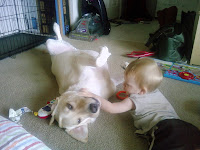
- Golden/Labrador Retriever- This one is a toss-up between the two. My personal preference as the proud mama to a yellow lab is obviously the labrador.
The golden, however, seems to be a bit quieter than the lab, as well as less needy. If you own a labrador, it will be in your lap a large portion of the time or dropping a tennis balls at your feet constantly. A golden will doubtless want to play, but may be less persistant, and happily lie down if you ignore him. Both dogs shed quite a bit, but the hair of the golden is much more visable on your floors, and a golden will need more regular grooming as well as occasional trimming.
- English Bulldog- Quick! Somebody on drool patrol! English bulldogs are a jolly and good natured breed, and although it won't bother the kids, the drooling can bother some adults. These dogs don't have the activity level to suit many active families, but for those who don't want a labrador retreiver roaring through the house knocking over everything in sight, an English bulldog is a great, couch potato dog.
- Pembroke Welsh Corgi- The corgi is a great fit for families who want a smaller dog. Many small dogs are fragile and can be nippy with rough children. The corgi, however, is a great fit for families with children of all ages and is hardy enough to put up with rough playtime (though children should always be supervised with any dog).
- Mixed breed- This one might really belong at the top of the list. Mixes are often very good family dogs. Usually mutts inherit the best personality traits of both parents. I had 2 mixed breed dogs growing up, and own a mixed breed now who is fantastic with my 9 month old, and has been since day 1. They tend to have very high pain tolerences and lot of patience. If you adopt a dog from a shelter, be sure to perform some basic behavioral tests to ensure that the dog is suitable. Many dogs who have suffered abuse or neglect have issues that make them dangerous around small children.

Remember that all dogs have their limits. No young child should ever be left unsupervised with a dog of any size. Socialization and basic training, even with little dogs, is crucial to ensuring that your dog is able to be the best family member which he/she can be.
Thursday, July 29, 2010
Boredom with a Baby

Amazing Obstetrician
I could only dream of having an obstetrician who was this caring and open minded. My own ob was terrific and I love her. But she is like most doctors-set in her ways. I never thought to ask about pitocin at one of my appointments.
I figured if my labor stalled or I needed an induction, the topic would arise. I never thought that the virtual moment I walked into my LDR room I'd be started on a drip. The nurse typed in my info, checked my cervix, started me on iv fluids, and strapped the monitor on. Once I had a few contractions, the nurse told me they would give me a little pitocin, just to "tighten my contractions up to 2-3 min apart" as opposed to the respectable 3-5 which they had been. I tried to protest, citing that I'd rather walk if my contractions needed upping. Nononononono, I was told. I was to lie there so that they could get good readings on the baby and make sure he was responding well. Basically, "don't rock the boat." The nurse assured me that once my contractions got going they could taper me off of the pitocin. Ok...... A few hours later I found my pitocin being upped by the second shift nurse. At this point, has my doctor even seen me? No, but apparently my labor isn't hopping along fast enough. Will definately be making a point to discuss this issue early on with the next pregnancy.
I thought obs who believed in hypnosis, and labor without epidurals in general were just like unicorns- nice to imagine, but not real. It makes me think about finding another doctor. I do love my doctor. She's very nice, makes a point to ask me if I have questions, and even prods me if I don't ask much. She was very encouraging during the actual delivery, and checked up on me quite a few times after the birth. Not to mention, almost all of my female family members go to her and she attends my parents' church, so if I ever felt I had to switch...yikes!
So, what have your own childbirth experiences been like? Did your ob or midwife handle your pre-natal, labor/delivery, and postnatal care in a way that you liked? What would you have changed?
Wednesday, July 28, 2010
Natural Sex Selection
The Race is On
According to this theory, if a couple has sex on ovulation day, or very close to it, the chances are very high that one of the quick little male sperm will reach the egg first, and a boy will be conceived. If a couple has sex a few days in advance of ovulation, the male sperm will exhaust themselves and die off after a day or two of hard swimming. This will leave a higher concentration of stronger XX sperm waiting when the egg is released. The chances of conceiving a girl will be much higher in this scenerio.
Acidity Factor
Another big factor in determining which sperm have the advantage is the acidity level of the environment (vagina). Shettles argues that male sperm (being smaller and weaker) have less tolerance for a highly acidic environment than the larger female sperm. They prefer an alkaline space. How is this achieved? Female orgasm. If the woman orgasms during sex before the man does, her vagina will be more welcoming to male sperm. If the woman does not orgasm, the environment will be far more acidic. This will favor the female sperm, making conception of a girl more likely.
Personal Experience
The Shettles method makes a lot of sense to me. We used an ovulation prediction kit when conceiving our son. This pinpoints the hormone surge which precedes ovulation by a day or two. We waited to attempt to conceive that cycle until the hormone surge was detected. This means that the sperm were depositited fairly close to when I was going to ovulate. Viola! We conceived a boy!
I'm not sure if we're going to use the Shettles method or not for our next attempt at conception (whenever that may be). We would love to have multiple boys, but a girl next in line would be comforting. That way, knowing we had one of each, we wouldn't care if the 3rd was a boy or girl. As much as I love my son, I really would rather not have 3 boys. We'll get what we're meant to have, so I don't know if we can really control anything anyway. If the Lord wants me to have all boys, I'll have all boys, and if I'm to have 2 girls and a boy, or 2 boys and a girl, than that's what will happen. The book has been interesting, though, and I've enjoyed reading it.